
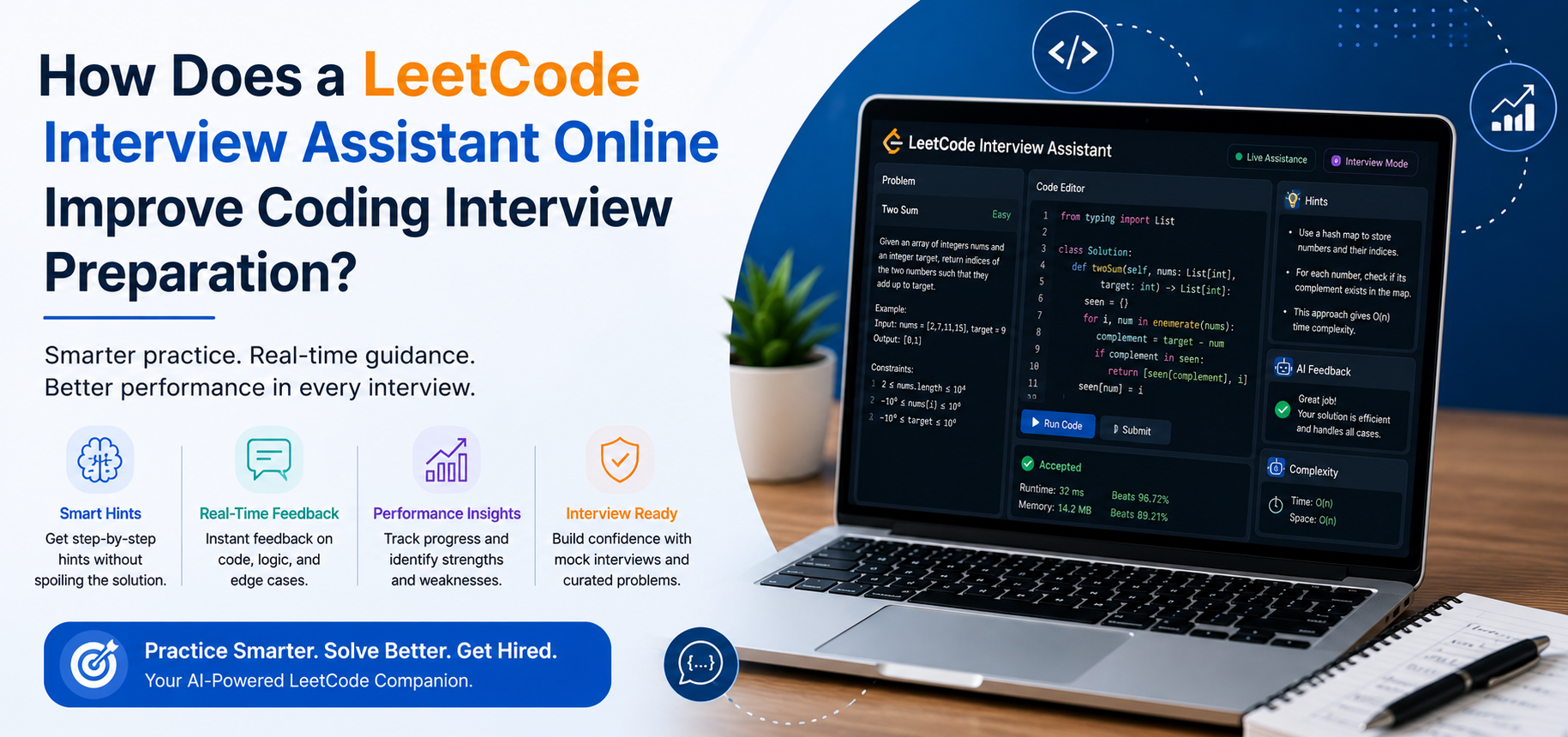
Coding interviews demand consistent practice, logical thinking, and the ability to solve challenging problems within strict time limits. Many candidates possess solid programming knowledge but struggle to organize preparation effectively. A LeetCode interview assistant online helps create a structured preparation process by combining coding exercises, interview simulations, progress tracking, and personalized recommendations. Rather than relying on random practice sessions, candidates can focus on measurable improvement across multiple technical areas while developing stronger problem-solving habits and greater confidence before important interviews.
Why does structured interview preparation matter?
Technical interviews evaluate more than coding speed. Interviewers assess problem-solving ability, communication, optimization skills, and decision-making under pressure. Consequently, preparation should address every aspect instead of focusing on isolated programming exercises.
A structured assistant creates a clear learning path by organizing questions, monitoring progress, and highlighting improvement opportunities. Moreover, candidates spend less time deciding what to practice and more time solving meaningful challenges.
Well-planned preparation also reduces unnecessary repetition. Instead of revisiting familiar topics repeatedly, candidates receive direction toward weaker areas that require additional attention.
Building Strong Problem-Solving Skills
Every successful coding interview depends on logical thinking. Therefore, improving analytical skills should remain a primary objective throughout preparation.
Breaking Problems into Smaller Steps
Complex programming challenges often appear intimidating at first glance.
An effective assistant encourages candidates to separate large problems into manageable components before writing code. This structured approach improves solution quality while reducing mistakes caused by rushed decisions.
Furthermore, practicing this method repeatedly creates a consistent problem-solving process that becomes easier to apply during interviews.
Recognizing Common Algorithm Patterns
Many interview questions follow recognizable algorithmic patterns.
Preparation should include repeated exposure to topics such as:
Arrays
Strings
Hash Maps
Linked Lists
Trees
Binary Search
Graph Traversal
Dynamic Programming
Sliding Window
Two Pointers
Greedy Algorithms
Backtracking
Instead of memorizing answers, candidates strengthen pattern recognition and improve solution accuracy.
Providing a Realistic Coding Environment
Interview preparation becomes more effective when practice closely resembles actual technical interviews.
A quality LeetCode interview assistant online should simulate realistic coding sessions that encourage efficient thinking and careful implementation.
Interactive Coding Workspace
Candidates benefit from an editor that supports professional coding workflows.
Useful features include:
Syntax highlighting
Automatic indentation
Code execution
Custom test cases
Multiple programming languages
Immediate compilation
These capabilities help candidates practice comfortably while reducing distractions.
Time-Based Coding Sessions
Most technical interviews involve strict time constraints.
Consequently, timed practice sessions improve decision-making and encourage efficient problem solving without sacrificing code quality.
Repeated exposure to timed challenges gradually increases confidence under pressure.
Immediate Feedback Improves Learning
Delayed feedback slows improvement.
Instead, candidates should receive detailed evaluations immediately after submitting solutions.
Code Correctness Analysis
An assistant should verify whether solutions satisfy every required test case.
Moreover, failed cases should include enough detail to help candidates identify the source of each mistake instead of simply displaying incorrect results.
This process encourages continuous improvement after every practice session.
Performance Evaluation
Correct answers represent only part of successful interview preparation.
Candidates should also review:
Execution speed
Memory consumption
Algorithm efficiency
Code readability
Optimization opportunities
These insights help candidates produce stronger technical solutions during interviews.
Personalized Learning Paths
Every candidate begins preparation with different technical strengths.
Therefore, an assistant should adjust recommendations according to individual performance.
Skill Assessment
Initial assessments identify current knowledge across multiple technical subjects.
Candidates can then focus additional practice on weaker topics while maintaining existing strengths through regular revision.
Consequently, preparation becomes more balanced and efficient.
Adaptive Practice Recommendations
Instead of assigning random coding problems, intelligent recommendations should consider:
Previous accuracy
Recently completed topics
Frequently missed concepts
Average completion time
Difficulty progression
This personalized approach keeps preparation challenging without becoming overwhelming.
Tracking Long-Term Progress
Consistent measurement helps candidates remain motivated throughout preparation.
Without clear progress reports, improvement often becomes difficult to evaluate.
Performance Dashboards
A useful dashboard should display information such as:
Questions completed
Accuracy percentage
Strongest topics
Weakest subjects
Coding consistency
Weekly activity
Improvement trends
Visual reports make preparation easier to manage while encouraging regular practice.
Goal Setting
Preparation becomes more organized when candidates define measurable objectives.
Examples include:
Complete fifty coding problems.
Improve graph algorithm accuracy.
Reduce average solving time.
Finish five mock interviews.
Master dynamic programming.
Breaking larger objectives into smaller milestones supports steady progress throughout preparation.
Strengthening Algorithm Knowledge
Algorithms remain central to technical interviews.
Consequently, an effective preparation assistant should organize algorithm practice logically rather than presenting unrelated challenges.
Gradual Difficulty Progression
Candidates should begin with fundamental concepts before moving toward advanced topics.
A structured progression prevents frustration while encouraging continuous improvement.
Moreover, confidence grows naturally as increasingly difficult challenges become manageable.
Regular Revision
Algorithm mastery depends on repetition.
Scheduled revision sessions reinforce previously completed concepts and reduce the likelihood of forgetting important techniques before interviews.
Candidates also identify recurring weaknesses more quickly through repeated practice.
Mock Interviews Build Confidence
Practice sessions differ significantly from real interview environments.
Therefore, realistic interview simulations play an important role in preparation.
Interview Simulations
Mock interviews should recreate actual technical interview conditions by combining:
Timed coding
Problem explanations
Follow-up questions
Optimization discussions
Final solution review
These activities prepare candidates for realistic interview conversations instead of isolated coding practice.
Pressure Management
Interview anxiety affects many candidates regardless of technical ability.
Regular simulations reduce uncertainty by creating familiarity with common interview situations.
Consequently, candidates communicate more confidently while solving problems under time constraints.
Supporting Multiple Programming Languages
Programming language flexibility allows candidates to prepare using familiar tools.
A reliable assistant should support widely used languages such as:
Python
Java
C++
JavaScript
Go
C#
Kotlin
Moreover, switching languages should remain simple whenever candidates wish to compare different implementations.
Improving Code Quality
Writing functional code represents only one aspect of interview success.
Interviewers also value clean, organized, and maintainable solutions.
Readable Code Structure
Candidates should practice:
Meaningful variable names
Clear function organization
Logical formatting
Consistent indentation
Simple control flow
Well-structured code demonstrates professionalism while making explanations easier during interviews.
Optimization Techniques
After producing a correct solution, candidates should evaluate opportunities to improve efficiency.
Reviewing time complexity, reducing unnecessary operations, and simplifying logic creates stronger technical performance during interviews.
Behavioral Preparation Complements Technical Skills
Technical interviews frequently include behavioral discussions alongside coding challenges.
Consequently, preparation should include communication practice as well as programming exercises.
Candidates benefit from reviewing common topics, including:
Team collaboration
Conflict resolution
Leadership situations
Project planning
Deadline management
Technical decision-making
Practicing organized responses improves confidence while creating more natural interview conversations.
Developing Better Time Management
Many candidates know the correct solution but fail to complete coding tasks within the available time.
A LeetCode interview assistant online helps improve pacing by measuring solving speed across different categories and encouraging gradual improvement.
Regular timed practice also reveals habits that reduce productivity, allowing candidates to make targeted adjustments before actual interviews.
Enhancing Communication During Interviews
Strong technical skills create opportunities, yet clear communication often determines interview success. Therefore, candidates should practice explaining their thought process while solving coding problems.
Explaining Every Decision
Interviewers evaluate reasoning as carefully as final answers. Consequently, candidates should describe why they selected a specific algorithm, how they identified edge cases, and why one solution performs better than another.
Regular explanation practice creates structured thinking while improving confidence during technical discussions.
Receiving Communication Feedback
An effective assistant should evaluate more than code.
Helpful feedback areas include:
Logical flow
Technical clarity
Conciseness
Confidence
Explanation structure
These insights help candidates communicate solutions naturally without sounding rehearsed.
Supporting System Design Preparation
Many technical interviews include system design discussions, particularly for experienced candidates. Therefore, preparation should extend beyond algorithm practice.
Core Architecture Concepts
Candidates should strengthen their knowledge across subjects such as:
Scalability
Distributed systems
Caching
Database selection
Load balancing
Fault tolerance
Message queues
Data partitioning
Reviewing these concepts alongside coding creates balanced interview preparation.
Scenario-Based Design Practice
System design improves through practical application.
Preparation should include architecture challenges involving file storage platforms, messaging services, search systems, online marketplaces, and notification services. Consequently, candidates strengthen decision-making while evaluating multiple architectural approaches.
Revision Becomes More Effective
Interview preparation often lasts several weeks or months. Accordingly, revision tools remain essential for maintaining consistent progress.
Bookmarking Difficult Problems
Candidates should save questions that require additional attention.
Bookmarks help organize:
Frequently missed questions
Advanced algorithms
Favorite solutions
Revision priorities
This feature simplifies future review sessions while reducing unnecessary searching.
Scheduled Review Sessions
Regular revision strengthens long-term retention.
Instead of revisiting topics randomly, scheduled review sessions encourage candidates to refresh weaker concepts before they fade from memory. Consequently, important algorithms remain familiar throughout preparation.
Using Analytics to Improve Performance
Preparation produces better results when candidates evaluate measurable progress.
Meaningful analytics should include:
Accuracy trends
Average solving time
Difficulty progression
Topic completion
Coding consistency
Mock interview scores
Moreover, visual reports help candidates identify weaknesses quickly and adjust preparation strategies without unnecessary guesswork.
Customization Creates Better Learning
Every candidate prepares differently. Therefore, customization options improve flexibility while supporting individual goals.
Useful settings include:
Preferred programming language
Daily practice targets
Topic selection
Session duration
Reminder schedules
Difficulty preferences
Personal notes
These features create a preparation routine that fits different learning styles and available schedules.
Maintaining Consistency Throughout Preparation
Consistency matters more than occasional intensive practice.
Short, focused sessions completed regularly produce greater long-term improvement than irregular study patterns. Moreover, consistent coding reinforces algorithm recognition, strengthens logical thinking, and improves confidence before interviews.
Candidates also develop better habits by reviewing previous mistakes instead of rushing toward new questions every day.
Avoiding Common Preparation Mistakes
Many candidates reduce their progress through preventable mistakes.
Consider avoiding these habits:
Practicing only easy problems.
Ignoring optimization after finding a correct solution.
Skipping behavioral preparation.
Neglecting communication practice.
Avoiding mock interviews.
Ignoring weak technical topics.
Memorizing solutions instead of solving independently.
Practicing without reviewing mistakes.
Changing programming languages frequently.
Focusing only on question quantity.
Correcting these habits creates a more productive preparation process.
Signs of an Effective Interview Assistant
Choosing the right preparation tool requires careful evaluation.
An effective LeetCode interview assistant online should provide:
Realistic coding environments
Immediate feedback
Personalized recommendations
Progress tracking
Mock interviews
Behavioral preparation
System design support
Performance analytics
Revision tools
Flexible customization
Combining these capabilities creates a balanced preparation experience that supports continuous improvement.
Preparing for Long-Term Success
Interview preparation should strengthen lasting technical ability rather than temporary memorization.
Candidates benefit from building habits that encourage structured problem solving, thoughtful communication, consistent revision, and regular performance evaluation. Consequently, every practice session contributes to meaningful improvement rather than isolated progress.
Well-organized preparation also helps candidates approach interviews with greater confidence because they have practiced under conditions that closely resemble actual technical assessments.
Conclusion
A LeetCode interview assistant online improves coding interview preparation by combining structured practice, personalized recommendations, realistic simulations, meaningful feedback, and measurable progress tracking. Candidates who prioritize consistent preparation, communication skills, algorithm mastery, and systematic revision strengthen both technical performance and interview confidence. Selecting a solution with these capabilities creates a focused preparation process that supports continuous improvement and stronger results during competitive technical interviews.
FAQs
1. What is a LeetCode interview assistant online?
A LeetCode interview assistant online is a preparation platform that helps candidates practice coding problems, monitor progress, complete mock interviews, improve communication, and strengthen technical skills through structured learning paths and detailed performance feedback.
2. How does it improve coding interview preparation?
It organizes practice sessions, identifies weak topics, provides realistic coding environments, delivers immediate feedback, and measures improvement through analytics. Consequently, candidates prepare more efficiently while building confidence across multiple technical subjects.
3. Are mock interviews necessary?
Yes. Mock interviews simulate actual interview conditions, helping candidates improve communication, time management, and decision-making under pressure. Regular simulations also reduce uncertainty before real technical interviews.
4. Why is progress tracking important?
Progress tracking highlights strengths, weaknesses, consistency, and improvement trends. These insights help candidates focus additional practice where it delivers the greatest benefit instead of repeating familiar topics unnecessarily.
5. Should beginners use an interview assistant?
Yes. Beginners benefit from structured learning paths, gradual difficulty progression, and organized practice sessions. Starting with fundamental concepts creates a strong technical foundation before moving toward advanced interview challenges.
6. Which programming languages should be supported?
A quality assistant should support commonly used languages including Python, Java, C++, JavaScript, Go, C#, and Kotlin. Multiple language options allow candidates to prepare using their preferred programming environment.
7. Does behavioral preparation matter for technical interviews?
Yes. Behavioral interviews evaluate communication, teamwork, leadership, adaptability, and decision-making. Practicing structured responses improves clarity while helping candidates answer confidently during interview conversations.
8. How often should coding practice take place?
Regular practice produces better long-term improvement than irregular intensive sessions. Consistent coding reinforces algorithms, improves solving speed, strengthens confidence, and helps candidates retain important concepts before interviews.
9. Why should candidates review previous mistakes?
Reviewing mistakes prevents repeated errors while strengthening conceptual knowledge. Careful analysis also improves algorithm selection, optimization skills, and confidence when similar problems appear during future practice or interviews.
10. What features deserve the highest priority?
Candidates should prioritize realistic coding environments, immediate feedback, personalized recommendations, mock interviews, behavioral preparation, system design support, progress analytics, revision tools, customization options, and secure data management when selecting an interview preparation assistant.