
Coding interviews test more than the ability to produce working code. Candidates often need to interpret requirements, choose suitable algorithms, evaluate trade-offs, handle edge cases, test assumptions, and explain reasoning clearly. An effective coding interview assistant should strengthen these abilities rather than simply generate solutions. During coding interview preparation, AI can provide structured practice, feedback, debugging support, and technical explanations. However, candidates still need programming knowledge and independent judgement. Evaluating an AI coding interview helper therefore requires looking beyond code generation and considering how effectively it supports genuine problem-solving skills.
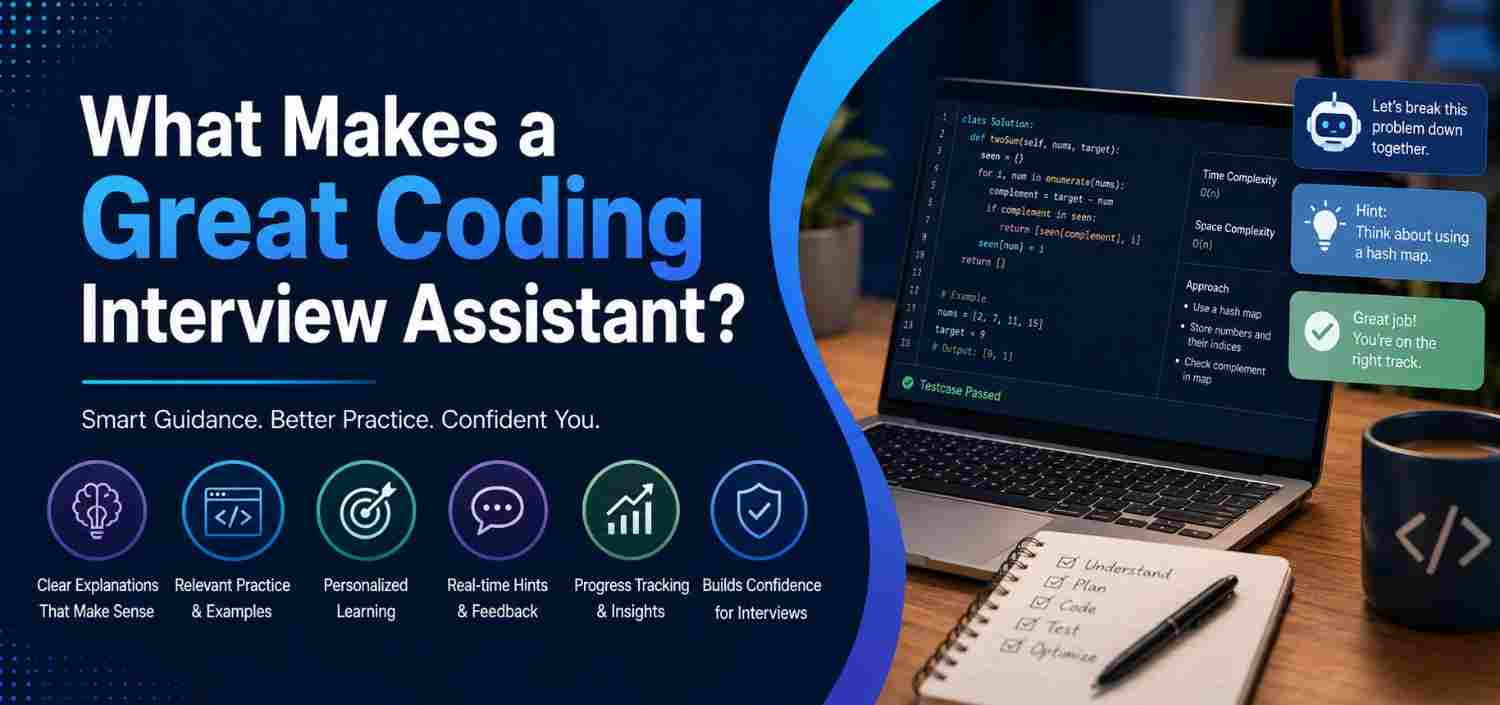
Clear Interpretation of Coding Problems
A useful assistant should help candidates break complex coding problems into manageable components without immediately removing the challenge.
Identifying Requirements and Constraints
Technical interview practice often begins with interpreting what a problem actually requires. Candidates may overlook input constraints, expected outputs, unusual conditions, or assumptions hidden within a prompt.
An AI coding assistant can support preparation by helping users identify:
Inputs, outputs, and constraints
Important assumptions
Potential ambiguities
Relevant edge cases
Appropriate data structures
Expected performance requirements
However, candidates should attempt their own interpretation first. Immediate reliance on generated analysis can weaken the independent reasoning that software engineering interviews commonly require.
Strong Algorithms and Data Structures Support
Algorithms and data structures form an important part of many coding interviews. Useful assistance should connect technical concepts with practical problem-solving decisions.
Explaining Why an Approach Works
Generating a final algorithm provides limited educational value if the candidate cannot explain it. Effective assistance should clarify why a particular approach fits the problem, which assumptions support it, and where limitations appear.
For example, preparation may involve comparing arrays, hash maps, stacks, queues, trees, graphs, heaps, or other structures according to the problem requirements.
Comparing Alternative Solutions
Many coding problems allow several valid approaches. A useful assistant should encourage comparison rather than presenting one solution as automatically optimal.
Candidates can examine a straightforward approach first, then consider alternatives based on readability, scalability, implementation complexity, time complexity, and space complexity. This process develops stronger technical judgement.
Code Review and Debugging Capabilities
Writing code forms only part of technical assessments. Candidates also need to recognise errors and explain how they would correct them.
Finding Logical and Implementation Problems
Debugging assistance can help identify syntax problems, incorrect conditions, indexing errors, faulty loops, state-management issues, or incorrect assumptions. More importantly, feedback should explain why an error occurs instead of merely replacing faulty code.
Candidates should then reproduce the correction independently to confirm that they grasp the underlying issue.
Analysing Edge Cases and Test Cases
Solutions that work for common inputs may fail under boundary conditions. Strong code analysis should encourage candidates to consider empty inputs, duplicate values, minimum or maximum constraints, unusual ordering, invalid assumptions, and other relevant conditions.
Test-case analysis also helps candidates trace execution and check whether their implementation satisfies the original requirements.
Complexity Analysis and Technical Explanation
Interviewers may ask candidates to evaluate efficiency and justify design decisions. Therefore, coding practice should include explanation as well as implementation.
Evaluating Time and Space Complexity
A coding assistant can help users review complexity analysis and identify operations that affect runtime or memory usage. However, generated complexity claims require verification.
Candidates should independently determine how loops, recursion, sorting, data structures, and repeated operations affect performance. They should also check whether stated complexity matches the actual implementation.
Building Clear Technical Communication
A technically correct solution can still be difficult to evaluate if the candidate cannot articulate the reasoning behind it. Mock coding interviews can encourage candidates to explain assumptions, describe their approach, discuss trade-offs, and justify changes while solving problems.
This practice supports communication skills that matter across technical assessments and collaborative software development.
Flexible and Context-Aware Practice
Candidates have different skill levels, preferred programming languages, target roles, and preparation priorities. Useful AI support should adapt without taking control of the entire process.
Progressive Difficulty and Practice Questions
Practice question generation can help candidates work through progressively harder challenges. Someone revising basic arrays may need different exercises from a candidate preparing for advanced graph or dynamic programming problems.
Multiple programming-language support can also help users practise in the language relevant to their technical interview.
Controlling the Level of Assistance
User control matters. Candidates may sometimes want a small hint rather than a complete solution. At other times, they may need detailed feedback after completing an attempt.
Effective preparation can follow a progression: attempt independently, request a hint when necessary, test the solution, analyse mistakes, compare alternatives, and then solve a related problem without assistance.
Accuracy Requires Independent Verification
AI-generated coding suggestions can contain errors. A proposed solution may include invalid syntax, faulty logic, inefficient operations, missed edge cases, incorrect complexity analysis, or assumptions that conflict with the original constraints.
Candidates should never treat generated output as automatically correct.
Instead, they should test code independently, inspect assumptions, create additional test cases, compare alternative approaches, and verify that the implementation meets every stated requirement. Moreover, official language documentation and reliable technical resources can help confirm unfamiliar behaviour.
AI feedback can support reasoning, but verification remains part of responsible technical preparation.
Responsible Use in Coding Interviews
AI-assisted preparation differs significantly from unauthorised assistance during a live recruitment evaluation.
Preparation Versus Live Assessment Assistance
Candidates can use permitted tools for mock coding interviews, debugging exercises, concept revision, practice questions, and feedback before an assessment. These activities can strengthen preparation when users remain actively involved.
In contrast, secretly obtaining AI-generated solutions during a live interview, coding test, or recruitment assessment may violate the applicable rules. Candidates should check employer or assessment instructions before using external assistance.
Responsible preparation should demonstrate genuine capability rather than create a false impression of technical knowledge.
Conclusion
A strong coding interview assistant does more than produce code. It supports problem interpretation, algorithms, data structures, debugging, edge-case analysis, test cases, complexity analysis, alternative approaches, technical communication, and structured practice. Accuracy also matters, so candidates should test generated solutions and verify technical claims independently. Most importantly, AI should reinforce rather than replace programming fundamentals and critical thinking. Candidates who use these tools responsibly can focus on analysing mistakes, refining explanations, and practising varied problems while preserving the independent reasoning expected during legitimate technical interviews.